Monday, February 18, 2013

Purification is best in Sweet Silent Solitude!


CONTENT WHEN UNDERSTANDING
Solitude is happiness for one, who is content,
Who sees and clearly understands this Dhamma.
Harmlessness is happiness in all worlds,
Kindness towards all living beings. :-)
Udana 10


IDEAL SOLITUDE

Avoid going along with fools. Should one fail to find
any one, who is better or equal as a good companion,
then one should continue this journey all alone.
Since there can be no friendship with fools...
Dhammapada Illustration 61 Background Story 61


SWEET & NOT LONELY
The one who has tasted the sweetness of solitude
in cooled calm, such one fears not, and wrongdo not,
since so indeed is the sweet joy of true Dhamma!
Dhammapada Illustration 205 Background Story 205

SOLITUDE AS NECESSITY
If one cannot find a clever companion, upright, straight and determined,
then walk alone like a king leaving the kingdom, like an Elephant freely
roam in all the forest...
Dhammapada Illustration 329 Background Story 328-330


SOLITARY FREEDOM
Life in solitude is better than friendship with the fool.
Let the one live alone, acting only right, freed from greed,
Like the Bull Elephant freely roam in all the forest.
Dhammapada Illustration 330 Background Story 328-330


THE MASTER
Mastering the hands.
Mastering the feet.
Mastering the speech.
Mastering the thoughts.
Highest Master of Mind;
Concentrated and composed,
Calm and content in secluded solitude,
Such one is indeed rightly called a Bhikkhu ...
Dhammapada Illustration 362 Background Story 362

Comments: Be realistic!
If one cannot be in company with one-self, then something must be wrong!
Any form of company will dissolve, since all meetings end in separation...
The ever socializing parrot-like personality cannot ever end suffering!
Only dead fish float with the stream!

More on Sweet Secluded Solitude:
Alone yet Free, Ideal Solitude, The_Rhinoceros_Horn!
Sweet Solitude!
Have a nice & noble day!
signature.picBowing_Bhikkhu 
Friendship is the Greatest! Bhikkhu Samāhita _/\_ ]
http://What-Buddha-Said.net

BUDDHIST QUOTES IN MALAYALAM


Thursday, February 14, 2013

Non-Control makes U into a Monkey-Robot!


Buddha once asked: How, Bhikkhus and friends, is there non-control?

Seeing a form with the eye, one becomes attracted by the pleasing form,
while repelled by the displeasing form. Having heard a sound with the ear,
one becomes attracted by the charming sound, while repulsed by a horrid
sound. Having sniffed a smell with the nose, one becomes attracted by the
lovely smell, while repelled by a detestable smell. Having tasted a flavour
with the tongue, one becomes attracted by the liked taste, while repelled
by a disliked taste. Feeling a touch with the body, one becomes attracted
by the pleasant touch, while repelled by any unpleasant touch. When one
experiences a mental phenomenon with the mind, one becomes attracted
by the agreeable mental phenomenon, while repelled by any disagreeable
mental phenomenon. In this uncontrolled way does such mind live without
having established Awareness of the body, & confined by a limited mind!
Therefore does such one neither understand, nor experience that release
of mind, that mental liberation through understanding, wherein those evil
detrimental states cease without remaining trace. In exactly this way
is there non-control!
Comments:
The limited & finite mind is a mind not made infinite by the praxis of the
4 sublime or 'divine abodes' (brahma-vihāra), also called the four infinite
mental states (appamaññā), which are:

Please UPDATE your mental SOFTWARE before social CRASH!
Source (edited extract):
The Grouped Sayings of the Buddha. Samyutta Nikāya. Book IV [189-]
35: 6 Senses. Salayatana. States that entail Suffering. Dukkha-Dhammā.
http://www.pariyatti.com/book.cgi?prod_id=948507
http://www.accesstoinsight.org/canon/samyutta/index.html
Taming the Monkey-Mind!
Have a nice & noble day!
signature.picBowing_Bhikkhu 
Friendship is the Greatest! Bhikkhu Samāhita _/\_ ]
http://What-Buddha-Said.net

What is the Cause of Contentment?


The blessed Buddha once said:Contentment (santutthi) is the Highest Treasure!
Dhammapada 204

Solitude is happiness for one who is content,
Who clearly sees and understands this Dhamma.
Udana 10


What is the proximate cause of contentment?

Mutual joy with others success is the proximate cause of contentment...
Therefore: If one is always gladdened by other's success, one will always be content!
Therefore:  If one is never gladdened by other's success, one will always be discontent!
Therefore is contentment caused by an altruistic mental state & not by external richness...
Example: Rich people possessing all the things they ever desired, can still be very discontent!
And vice versa: Poor people not having much, can still be very content and very much smiling!

Great Contentment even with almost nothing!
How to cultivate mutual joy & thus increase contentment:


Proof:
The above beings do not possess much, yet they are seemingly quite content!

Calm and Content!
Have a nice & noble day!
signature.picBowing_Bhikkhu 
Friendship is the Greatest! Bhikkhu Samāhita _/\_ ]
http://What-Buddha-Said.net

Wednesday, February 13, 2013

Maintain this Noble Wish of Sympathy:

May I be happy, may I sustain my happiness by living without trace of enmity.
May all beings be happy and successful: May they be full of joy, all beings
that breathe and have life, whether they are weak or strong, tiny or huge,
visible or invisible, near or far away, born or to be born, let all beings enjoy
safety, content ease and a peaceful serene bliss!
Let no one deceive another, let no one be harsh in speech, let no one by anger
or hatred wish bad for his neighbour. Even as a mother, at the risk of her life,
guards and protects her only child, so with a boundless heart of compassion,
I venerate all living beings by permeating this entire universe with sympathy,
above, beneath and all around, without limit, immeasurable and truly endless!
In this very fine way I cultivate an infinite goodwill toward this whole world.
Standing or walking, sitting or lying down, during all my waking hours I will
always treasure and dwell in this goodwill, knowing that this way of caring
is the most Noble in this entire universe!
Thus shall I, by stilling pointless discussions and controversies, and by acting
blamelessly, be gifted with tranquillity and true insight into what is profound.
Thus shall I subdue the urge for sense-pleasure, and never again know rebirth.
May this also inspire and thereby cause all other sentient beings to fulfil the
conditions leading swiftly to Nibbāna, which is the only lasting happiness!
May all sentient beings be thus liberated & fully released from all suffering.
May all sentient beings thus escape the dangers of ageing, disease, & death.
Friendliness is thus the Greatest! Yeah... :-)


More on this blazing Friendliness (Mettā):


On Biological Symbiosis="Living together with", an advantageous Social Model:
http://en.wikipedia.org/wiki/Symbiosis
http://www.ms-starship.com/sciencenew/symbiosis.htm

Creating a Future Harmony: So that we may sleep with our doors open,
among hanging gardens and dance with the children in our arms! :-)

Symbiotic Sympathy!
Have a nice & noble day!
signature.picBowing_Bhikkhu 
Friendship is the Greatest! Bhikkhu Samāhita _/\_ ]
http://What-Buddha-Said.net
--

A train runs where the Buddha walked


Daji World
February 02, 2013
Sarnath (Uttar Pradesh), Feb 2 (IANS): It’s a trip down the Buddha’s lane, into antiquity and serenity. Tracking the Buddha’s path, the Mahaparinirvana Express is for the historian, the tourist and, of course, the pilgrim seeking salvation in retracing the footsteps of the man who walked this land some 2,400 years ago.
The special train dedicated to Buddhist pilgrims does the circuit twice every month in the cooler months of the year – beginning from New Delhi and taking the traveller to places like Varanasi and Gorakhpur in Uttar Pradesh before getting into Gaya in Bihar.
Sarnath, where the Buddha gave his first sermon, is just 13 km from Varanasi. From Gorakhpur, travellers are taken to Kushinagar, where he died and attained mahaparinirvana (death, and ascent to “deathlessness”), and Lumbini, where he was born. And Gaya is where he attained enlightenment.
The train, which has been running for six years, takes a week to complete the tour. It is named after the Mahaparinirvana Sutra, the Buddha’s sayings in days preceding his death. (The association with death makes some people think Indian Railways should change the train’s name!)
It’s a train ride to history for some, spirituality for others.
At Sarnath, a solitary man sat chanting in a nook among the ruins. Other visitors peeped into bottomless wells, and wandered looking at the ruins of monasteries and what remains of Emperor Ashoka’s famous Sarnath pillar, the capital of which is the four-lion emblem of modern India.
The lone pilgrim sat hidden from sight by what, over 2,000 years ago, was the corner of a room. These days, the brick walls are just high enough to shield a man squatting on the ground from intrusive, photograph-seeking tourists.
A group of Thai pilgrims on the Mahaparinirvana ride sat cross-legged at the Mulagangha Kuti, the site in Sarnath where the Buddha is believed to have sat in meditation.
Only 200 years after he died, when Emperor Ashoka had converted to Buddhism, did many of these spots become sites for monasteries.
From Gorakhpur, the travellers take the bus to Kushinagar, about 50 km away, where the Buddha died after a brief spell of diarrhoea.
He is believed to have had a premonition of death, and travelled to this spot on the banks of the Hiranyavati river to make it convenient for followers to converge for his last rites.
At Kushinagar, an over six-metre terracotta statue of the Buddha lying on his side tells of a peaceful death. The Buddha died when he was nearly 80, but not a wrinkle mark is on the face of the statue, which has since been painted golden. (The red of the terracotta peeps through from the base.)
The Mahaparinirvana pilgrims then ride a bus nearly 160 km from Kushinagar into Lumbini, across the border with Nepal, where the Buddha was born. A large stone sculpture here shows baby Buddha emerging from his mother’s side. (Yes, side. That was where he was believed to have emerged from.)
Last month, the train for the first time made a trial run into Odisha, where there are ruins of ancient Buddhist monasteries, all constructed between 3rd and 5th century AD, at Udaigiri, Ratnagiri and Lalitgiri.
The cells of the monks are typically arranged around a central courtyard, and resting against the wall across the main entrance is a large, imposing statue of the Buddha. There are clear signs of vandalism on the statues — one large Buddha figure has the nose hewn out roughly, and sharp edges mark the hollow where the nose was.
Alexandar Cunnnigham, known as the father of the Archeological Survey of India, was renowned for excavating Buddhist sites in India in the mid-19th century. The Mahabodhi Temple in Gaya, about 95 km from Patna, Bihar’s capital, was among the important sites that Cunningham unearthed.
This temple marks the site where the Buddha gained nirvana or enlightenment.
There are many reasons to take the Mahaparinirvana ride. It’s not just about religion – there are 350 million Buddhists in the world – it’s also about delving into the ancient past.
And one’s orientation would colour what one sees. “What tourists on this circuit see are only ruins of great antiquity. For those who have not witnessed it, it’s hard to imagine the awe and devotion that pilgrims feel when they see these ruins,” said Joginder Gujjar of the Indian Railway Catering and Tourism Corporation (IRCTC).
The Mahanirvana Express begins from New Delhi’s Safdarjung station and ends there. Travel on the airconditioned train ranges from $700 per head to $1,120, including meals and the cost of travel to the various destinations.

A FRAGILE BUDDHIST TREASURE


 Image LMU
Image LMU
from Past Horizons; Article created on Friday, January 25, 2013
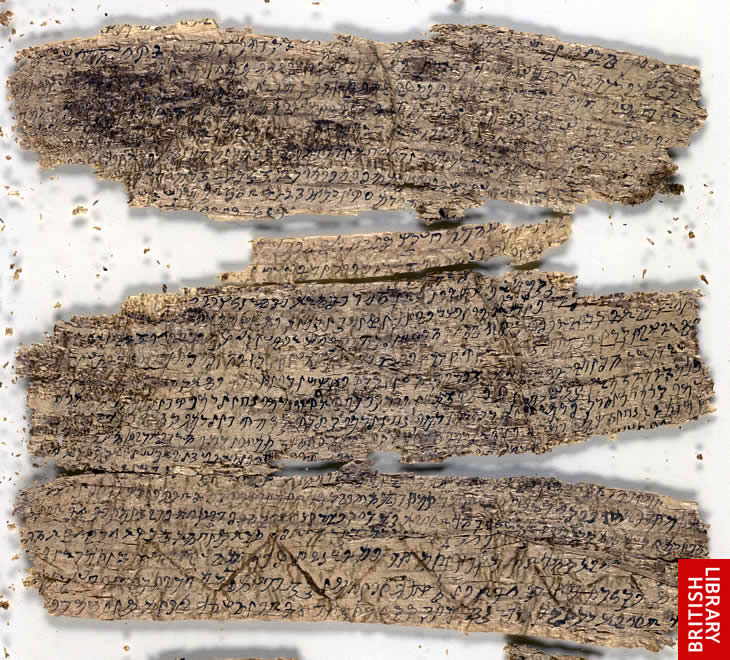
Experts at Ludwig-Maximilians-Universität München (LMU) are in the process of analysing Indian Buddhist texts that are over 2000-year-old which have recently come to light. The precious manuscripts have already yielded some surprising results. Birch-bark manuscript.
The texts of Ghandara
The oldest surviving Buddhist texts, preserved on long rolls of birch-tree bark, are written in Gandhari, an early regional Indic language that is long extinct. The scrolls originate from the region known in ancient times as Gandhara, which lies in what is now Northwestern Pakistan.
For researchers interested in the early history of Buddhism, these manuscripts represent a sensational find, for a number of reasons.
The first is their age. Some of the documents date from the first century BC, making them by far the oldest examples of Indian Buddhist literature. But for the experts, their contents are equally fascinating. The texts provide insights into a literary tradition which was thought to have been irretrievably lost, and they help researchers to reconstruct crucial phases in the development of Buddhism in India. Furthermore, the scrolls confirm the vital role played by the Gandhara region in the spread of Buddhism into Central Asia and China.
Birch-bark manuscript in the Kharosthi script. Image British Library
Restore, conserve, digitise, edit
At LMU a team of researchers led by Indological scholar Professor Jens-Uwe Hartmann and Professor Harry Falk of the Free University of Berlin has just begun the arduous job of editing the manuscripts.
Most of the texts survive only as fragments, which must first be collated and reassembled. The magnitude of the task is reflected in the planned duration of the project – 21 years.
The project of the Bavarian Academy of Sciences and Humanities is being funded by a total grant of 8.6 million euros from the Academies Program, that is coordinated by the Union of German Academies of Sciences and Humanities. It is one of the largest research programs in the field of the Humanities in the Federal Republic.
Fragile resource online
The research is not with the manuscripts themselves, but with digital scans. The originals are not only extremely fragile, but are held in various collections scattered around the world.
A large proportion of the surviving material is stored in the British Library in London.
The ultimate goal of the project is to prepare a modern edition of all the Gandhari manuscripts, making them available for further investigation and research. In addition, the researchers plan to produce a dictionary of the Gandhari language and it’s grammar based on the contents of these documents.
However, the project will be primarily concerned with illuminating the development of Gandhari literature and the history of Buddhism in Gandhara. It is already clear that the results will lead to a new understanding of the earliest phases of Buddhism in India.
Opening up new knowledge
Discoveries of these documents continue to be made and the understanding of the script and people is revolutionized by the recovery of 77 long birch-bark scrolls and around 300 palm-leaf manuscript fragments from Buddhist monasteries in the Gandhāran heartland.
Birch bark (bhoja-patra), like palm leaf, was a primary material used in India for writing before the introduction of paper and most of these early manuscripts have been destroyed, but accounts in ancient Greek literature even reveal birch bark’s usage in India at the time of Alexander’s invasion.
The oldest extant examples date to the 2nd or 3rd century CE, written with black ink in variants of the Sanskrit script. A recent publication on these manuscripts from the British Library states: “As the Dead Sea Scrolls have changed our understanding of Judaism and early Christianity, so early sets of scroll fragments promise to improve knowledge of the history of Buddhism.”
At the core of the project is the construction of a comprehensive database in which all relevant information and results are collected, stored and linked together. The database will serve as the major source of electronic and printed publications on the topic, and regular updates will give the international research community access to the latest results
Source: LMU Munich

Natural Bliss!

When there is No Need for anything at All:
The Buddha said on the need for Bliss:  Friends, for the virtuous one, correctly behaving, completed in morality, there is no need to wish:
 “May I enjoy a clear conscience”, since the right action, of correct behaviour completed by
 purifying morality, naturally results in the arising of a clear conscience.
Friends, for the moral one of clear conscience, there is no need to wish: “May gladness pervade me”,
since any clear conscience spontaneously is followed by the appearance of
joyous gladness!
Friends, for the glad one there is no need to wish: “May rapture thrill me”,
since gladness automatically excites exalted rapture. 
Friends, for the enraptured one there is no need to wish: “May calm tranquillity still me”,
since rapture inherently simply evaporates all urge and frustrated restlessness. 
Friends, for one dwelling in serene tranquillity there is no need to wish: “May pleasure perfuse me”,
since abiding calmly in tranquil ease all by itself, makes one delight in pleasure.
Friends, for one perfused by pleasure there is no need to wish: “May I be absorbed in concentration”,
since a mind filled with pleasure effortlessly & smoothly condenses into a single focused unification!
Friends, for one concentrated there is no need to wish: “May I understand reality as it actually develops”,
since the undistracted concentrated mind efficiently penetrates phenomena & causes as they really are.
Friends, for one knowing & seeing reality there is no need to wish: “May disgusted disillusion detach me”,
since seeing reality & knowing how it always becomes, induces detachment by disgusted disillusion.
Friends, for one detached by disillusion there is no need to wish: “May I realize final mental release
through absolute knowledge & vision”, since such disgusted disillusion, friends, naturally, readily, easily,
essentially & characteristically culminates in the matchless, unsurpassable & supreme releasing liberation
by complete knowledge & vision. Yeah, so mighty is morality!


The Buddha on more Bliss:
http://What-Buddha-Said.net/drops/V/Buddha_on_Bliss.htm


Source:
The Numerical Sayings of the Buddha: Anguttara Nikāya V 2-3

Have a nice & noble day!
signature.picBowing_Bhikkhu 
Friendship is the Greatest! Bhikkhu Samāhita _/\_ ]
http://What-Buddha-Said.net