Monday, August 19, 2013

Why and Why not?

Why do some gain Nibbãna, while most do not?

Sakka, the king of the 33 Gods, once asked the Blessed Buddha:
Venerable Sir, what is the cause & reason, why some beings here do not
attain Nibbāna in this very life? And what is the cause and reason, why
some beings here do indeed attain Nibbāna in this very life?
Knowing this being's addiction to divine delight the Buddha answered:
There are, King of the thirty-three Devas, forms experiencable by the eye,
sounds experiencable by the ear, smells experiencable by the nose, touches
experiencable by the body, and mental phenomena experiencable by the
mind, that all are attractive, charming, agreeable, pleasing, tempting, and
tantalizing. If a bhikkhu hunts for delight in them, welcomes them, and
remains holding on to them, his mind becomes addicted to them and clings
to them. Any being mentally dominated by clinging cannot attain Nibbāna! This is the cause & reason, King of the Devas, why many & most beings here
do not attain Nibbāna in this very life... Again: There are, King of the Gods,
forms experiencable by the eye, sounds experiencable by the ear, smells
experiencable by the nose, touches experiencable by the body, and mental
phenomena experiencable by the mind, that all are attractive, charming,
agreeable, pleasing, enticing, tempting and tantalizing.  If a wise Bhikkhu
avoids seeking any delight in them, does not welcome them, and does not
remain holding on to them, then his mind doesn't become addicted to them,
Any being mentally wholly freed of clinging can indeed attain Nibbāna! 
This is the cause and reason, King of the Devas, why some beings here can
attain Nibbāna in this very life, while most neither can, nor will....


king Sakka and a few of his hundreds of dear nymphs...
Source:
The Grouped Sayings by the Buddha. Samyutta Nikāya. Book IV 102
The 6 senses section 35. Thread on Sakka's Question: 118.
http://www.pariyatti.com/book.cgi?prod_id=948507
http://www.accesstoinsight.org/canon/samyutta/index.html

Have a nice & noble day!
signature.picBowing_Bhikkhu 
Friendship is the Greatest! Bhikkhu Samāhita _/\_ ]
http://What-Buddha-Said.net

Pain & frustration is there, but concealed by the hope for pleasure:


Buddha once said: Dukkhānupassanam bhāvento sukhasaññam pajahati...When developing the contemplation of Suffering (dukkha),
one gradually overcomes the false perception of pleasure...

If there were no satisfaction to be found in the world, beings would not be
attached to the world .... If there were no misery  to be found in the world,
beings would not be repelled by the world ....
If there were no escape from the world, beings could not escape from
this world .... AN 111, 102

The stage of Viewing:Each time one changes posture of the body, one should note, that this was
caused by bodily pain...
Each time one changes plan or search, one should know, that this was caused
by mental frustration...
Every time one has headache, toothache, any illness or sickness, one should see:
Painful is any body...
Every time one is disappointed, separated, or depressed, then one should note:
Any mind incurs grief...
To see & realize everyday misery, by not dismissing or neglecting it, is a very
advantageous teacher!


The stage of Comprehending:
Having seen & realized that both bodily & mental pain afflict us every minute, one may
understand, that this 'obvious pain' & suffering (dukkha-dukkha) is a common & inevitable
part of any existence.. When the body decays & grows old, & when the momentary pleasure,
joy or happiness fades away, one may realize the rise & inevitable fall of all conditioned
constructions and thereby comprehend that suffering is an unambiguous part of any
conditioned formation... This  hidden suffering is called 'suffering due to constructedness'
(sankhara-dukkha): All constructions will fall apart... Finally, there is the fact of impermanence,
which implies, that all found forms of worldly joy, satisfaction, pleasure and whatever kind of
happiness, will never last and thus quickly be lost... This causes a frustration, which is called
'suffering due to change' (viparināma-dukkha)... Gradually comprehending the abundance of
these 3 kinds of suffering makes one realize: All phenomena - even pleasant feeling - are nothing,
but one massed up heap of suffering!


The stage of Gaining Insight:
This ultra realism squeezes one out of the cocoon quite well camouflaged by common comfort...
The knowledge of inevitable Dissolution  of all phenomena and states arises (bhanga-ñāna)!
The knowledge of any appearance is a true Terror  arises (bhayatupatthāna-ñāna)!
The knowledge of the Danger  inherent in any form of dependent existence arises (ādinava-ñāna)!
The knowledge of the Disgust  with all things & states in any world arises (nibbidā-ñāna)!


The result of contemplating Suffering is absence of mental distortion (vipallāsa):
Direct and repeated experience of such disgust gradually detaches mind from its habitual
attachments by disclosing the universal defect of all these deeply cherished objects:
No form, feeling, perception, mental construction or kind of consciousness will ever last!
This violent revulsion break the misconception that the 5 clusters of clinging is a source
of true and lasting pleasure and happiness. This mistaken notion leads otherwise to the
hedonist distortion of perception (sañña-vipallāsa), distortion of thinking (citta-vipallāsa),
and distortion of view (ditthi-vipallāsa), which makes one perceive, think and claim the view:
"This world, this life, all formations & all phenomena are essentially pleasurable!"...
Such distortion makes one run after fleeting pleasure & evanescent happiness in a transient
world, as the thirsty & scorched man runs in hot pursuit for a water mirage fata morgana
in the completely dry desert... Seeing, comprehending and fully understanding this abysmal
futility redirects mind towards the deathless, safe, and lasting peace of Nibbāna...  

 
Pain & frustration afflicts us every minute ...
Have a nice & noble day!
signature.picBowing_Bhikkhu 
Friendship is the Greatest! Bhikkhu Samāhita _/\_ ]
http://What-Buddha-Said.net

False perception of permanence arises from conceiving apparent continuity:


Buddha once said: Aniccānupassanam bhāvento niccasaññam pajahati...When developing the contemplation of Impermanence (Anicca),
one gradually overcomes the false perception of permanence...

 
One cannot easily observe the characteristic of Impermanence, since it is obscured and
concealed by apparent continuity: Mind falsely conceives: This is the same as it was before...
One then wrongly perceives all psycho-physical phenomena as existing permanently and not
correctly as a sequence of discrete states ever arising and ceasing...

The stage of Viewing:By training one can observe the solidity, fluidity, heat and motion within ones own body
or externally as changing states by noting their beginning, middle and end.
Example: Noting the beginning, middle and end of the breath coming in or going out!

The stage of Comprehending:One then comprehends this breath, this materiality is not the same from moment to moment.
Nor is any other solidity, fluidity, heat or motion, the same from moment to moment...
Nor is any observing mind, thought or any mental state, the same from moment to moment...
Whether internally or externally: All this is only discrete states arising and ceasing...
Such cannot be lasting happiness... Such cannot be regarded as an essentially same self...
Such change is therefore suffering... Such transience is therefore no-self...


The stage of Gaining Insight:By observing wisely and repeatedly one thus understands, that all formations, all phenomena,
all conditioned constructions inherently are permeated with the 3 characteristics of:
1: Impermanence (Anicca), 2: Suffering (dukkha), and 3: Selflessness (anatta)...
Insight dawns when noting & knowing the Dissolution  of all phenomena (bhanga-ñāna),
which gives rise to noting & knowing the Danger  within all existence (ādinava-ñāna)...
By noting the impermanence of all internal form, feeling, perception, mental construction
and consciousness, one can generalize and extend this observed impermanence to also be
dominant in all external form, feeling, perception, mental construction and consciousness.
One can furthermore infer, that all phenomena in the past was impermanent, and so also
will all phenomena in the future be impermanent. This expands & matures the comprehension.
 
The result of contemplating Impermanence is absence of distortion (vipallāsa):The false perception of permanence actually comes from an -a priori- conceptual notion:
"All phenomena are permanent and endures as the same from moment to moment..."
This distortion of perception (sañña-vipallāsa) - arised from ignorance - then by repetition
then distorts thinking (citta-vipallāsa), which then later solidifies into a distortion of
view (ditthi-vipallāsa): One then perceives, thinks and views: Formations are all lasting!
This false conviction have been reified and reinforced through numberless accounts
of existence, since a indiscernible beginning, and is thus deeply ingrown and imbedded
in mind. However this triple distortion of perception, thinking and viewing can be broken
by repeated reasoned observation of & reflection on the universal aspect of impermanence.
This requires rationally directed attention (yoniso manasikāra) and clear comprehension
(sati-sampajañña)
and leads to knowing and regarding all formations with a pleasant
imperturbable equanimity... (sankhara-upekkhā-ñāna)...

All things break apart! Nothing is thus worth clinging to...
Have a nice & noble day!
signature.picBowing_Bhikkhu 
Friendship is the Greatest! Bhikkhu Samāhita _/\_ ]
http://What-Buddha-Said.net

Friday, August 16, 2013

Babasaheb Dr.B.R Ambedker Quotes on Indipendance


One day forum to explore Buddhism's adaptation to the 21st Century


The Buddhist Channel, August 16, 2013

Petaling Jaya, Malaysia -- The Buddhist Gem Fellowship (BGF) will be organizing a one day forum entitled "Adapting Buddhism to the 21st Century", The event is organized in memory of the late Ven Dr K Sri Dhammananda, commemorating his legacy as a far sighted monk.
The forum will be held at Hall 3, Level 1 of the Graduate Centre, Sunway University on August 31, 2013. Programme will feature talks from renowned Dharma teachers, scholars and practitioners from the United States, Singapore and Malaysia.
Among the venerable and lay speakers are Ven. Mahinda, Ven. Sing Kan, Dr Brooke Schedneck, Datuk Dr Victor Wee, Yap Ching Wi, Dr. Lim Tuck Meng, Tan Huat Chye and Lim Kooi Fong.
This forum invite participants to explore issues of balancing modernity and tradition, with a keynote address by Dr Brooke Schedneck showcasing a case study of Thailand, Burma and Cambodia. It will also discuss whether tradition is an obstacle or enabler of Buddhist growth. A panel discussion will cap off the day's programme by discussing new approaches to revitalize Buddhism.
A key event at the forum will the launching of the book "One Dharma: Many Buddhist Traditions - A Festschrift in Memory of K. Sri Dhammananda Maha Thera (1919 - 2006)". Edited and compiled by Benny Liow, the book is a compilation of articles written by students of the late venerable.
For more information and programme details, please visit:
http://bgf.org.my/index.php?31-aug-2013-adapting-buddhism-to-21st-century-forum-in-memory-of-ven-dr-k-sri-dhammanandas-7th-year-memorial
If you go:
Forum: Adapting Buddhism to the 21st CenturyHall 3, Level 1 of the Graduate Centre, Sunway University
Petaling Jaya, Malaysia
August 31, 2013
Special note to participants driving to the forum's venue:
Due to on-going expansion works, car parking bays on campus are limited. Visitors are advised to park vehicle at Sunway Pyramid, Entry C, Blue Zone and enjoy a scenic 6-minute walk to Sunway campus via the Canopy Walk which is located near the entrance to Sunway Lagoon.
Download map here

Wednesday, August 7, 2013

How to Feed the Energy Link to Awakening?

How to Feed the Energy Link to Awakening?

The Blessed Buddha once said:
Bhikkhus, just as this body, is sustained by feeding, exists in dependence
on feeding and cannot survive without food, so are the 7 Links to Awakening
also sustained by feeding, they can also only exist in dependence on feeding
and they cannot survive without feeding...
And what is the feeding of the emergence of any yet unarisen Energy and also
feeding of the very completion by advance of any already arisen Energy Link
to Awakening? There are these 3 elements of:
Initiative, Launching into effort and Endurance ...
Frequently giving careful and rational attention to them, is feeding the arising
of any unarisen Energy Link to Awakening and also feeding of the fulfillment
of any already arisen Energy Link to Awakening...
And what, Bhikkhus, is the starving that obstructs the emergence of any yet
unarisen Energy Link to Awakening & which also hinders any already arisen
Energy Link from reaching any fulfillment by deliberate development?
There are these three elements of:
Initiative, Launching and Endurance ...
Not giving frequent, careful and rational attention to them; not considering
them much and often; is the starving that prevents any unarisen Energy Link
to Awakening from arising and also blocks any already arisen Energy Link to
Awakening from reaching any complete fulfillment by training & development.
Comments from the classical commentaries:
Enthusiastic and eager exertion is the characteristic of the Energy Link to
Awakening (Viriya-sambojjhanga).  Effort producing advantage is the goal
of the Energy quality. Activity overcoming mental slack is the manifestation
of this Energy Link to Awakening.
While too lazy to do what should be done simply ask yourself:
What is missing here???
Is it the element of mental initiative wishing to get up that is missing here now,
or is it the element of actual bodily launching into effort that is missing here,
or is it the element of endurance, persistence, perseverance and stamina that
is missing here now? This discrimination - in itself - has the capacity to gradually
stir up and induce energy!
Further conditions helpful for the emergence of the Energy are:
1: Reflection on the long-term dangers of inactivity such as hell...
2: Reviewing the benefits to be gained by energetic praxis.
3: Remembering that no journey can ever be ended by a lazy one.
4: Giving credit to the good givers of the alms-food received.
5: Honouring the Greatness of the prior effort of the Master.
6: Honouring the Greatness of the prior effort of the Lineage.
7: Removing laxity by perceiving light, change of posture and open air.
8: Avoidance of slack, lazy, sluggish, negligent and careless people.
9: Friendship with enthusiastic, energetic and persistent people.
10: Reviewing the Four Right Efforts often and systematically.
11: Commitment and resolute determination to arouse more energy...
There is bodily energy and there is mental energy! Both are a crucial for
all progress towards any advantageous state. Awakening is Waking Up
from sloth and daydreaming!

Energy is the Fifth Mental Perfection:
http://What-Buddha-Said.net/drops/Enthusiastic_is_Energy.htm
Curing Laziness and lethargy:
http://What-Buddha-Said.net/drops/II/Curing_Lethargy_and_Laziness.htm
Get Moving Right Now:
http://What-Buddha-Said.net/drops/Arousal_Get_Up_and_Going.htm


For a full Study on Energy (Viriya): The root Hero of all Success:
http://What-Buddha-Said.net/drops/III/The_Definition_of_Energy.htm
http://What-Buddha-Said.net/drops/III/The_Arising_of_Energy.htm
http://What-Buddha-Said.net/drops/III/The_Ability_of_Energy.htm
http://What-Buddha-Said.net/drops/III/The_Origin_of_Energy.htm
http://What-Buddha-Said.net/drops/Enthusiastic_is_Energy.htm
http://What-Buddha-Said.net/drops/III/Power_of_Energy.htm
http://What-Buddha-Said.net/drops/III/Ballanced_Energy.htm
http://What-Buddha-Said.net/drops/III/The_Chief_Hero.htm
http://What-Buddha-Said.net/drops/III/Energetic_Effort.htm
http://What-Buddha-Said.net/drops/III/Avoiding_Effort.htm
http://What-Buddha-Said.net/drops/III/Feeding_Energy.htm
http://What-Buddha-Said.net/drops/III/Energy_Viriya.htm
http://What-Buddha-Said.net/drops/III/Dual_Energy.htm
Sources (edited extracts):
The Grouped Sayings of the Buddha. Samyutta Nikāya.
Book [V: 65-6+102-8] 46: Links. 2+51: Group & Nutriments....
Feeding the Enthusiasm!
Have a nice & noble day!
signature.picBowing_Bhikkhu 
Friendship is the Greatest! Bhikkhu Samāhita _/\_ ]
http://What-Buddha-Said.net

The 10 Contemplations is Daily Buddhist Routine!


The Blessed Buddha once said:
Bhikkhus & friends: There is one contemplation, which when often practiced
and developed leads to the complete turning away from the world, leads to
detachment, to stilling, to ceasing, to Peace, to final penetrating knowledge,
to Enlightenment, and thus indeed to Nibbāna...
Any Noble Disciple who by gradual progress has understood the Dhamma
dwells frequently in this state. Which is that one contemplation?
It is reflecting on the sublime qualities of the ultimate Peace like this:
This is peaceful, this is sublime, namely, the stilling of all kammic construction,
the leaving behind of all substrata of any becoming, the complete vanishing of
all sorts of craving, ceasing, relinquishment, release, Nibbāna...
Whatever, Bhikkhus & friends, there is of both conditioned and unconditioned
things, dependent & independent constructions, releasing detachment is always
considered the highest of them, that is, the final destruction of fake ego-belief,
the overcoming of all desire and thirst, the rooting out of clinging, the breaking
out of this long round of rebirths, the vanishing of craving by absolute release!
This -only this- is Nibbāna...
The Ultimate Peace!
Have a nice & noble day!
signature.picBowing_Bhikkhu 
Friendship is the Greatest! Bhikkhu Samāhita _/\_ ]
http://What-Buddha-Said.net

Faith is the Entrance to what Enlightens!


Faith comes mostly from the heart and less from the intellect.
Faith - in itself - is blind, but it initiates repeated observation,
that later grows into confidence and when fully confirmed it
culminates in conviction. Then the Faith has become Knowledge!
What is the cause of Faith?Suffering is proximate cause of Faith! When in pain we seek!
The 4 Factors of Stream-Entry is the Origin of Faith.
What are the four factors of Stream-Entry leading to Nibbana?


Buddha once explained:
Here, householder, the Noble Disciple possesses confirmed faith,
confidence & conviction in the Buddha in this way:
Worthy, honourable & perfectly self-Enlightened is the Buddha!
Consummated in knowledge and behaviour, totally transcended,
expert in all dimensions, knower of all worlds, unsurpassable
trainer of those who can be tamed, both teacher & guide of gods
as well as of humans, blessed, exalted, awakened & enlightened
is the Buddha !!!
He possesses confirmed confidence in the Dhamma in this way:
Perfectly formulated is this Buddha-Dhamma, visible right here &
now, immediately effective, timeless, inviting each and everyone to
come and see for themselves, inspect, examine & verify. Leading
each and everyone through progress towards perfection. Directly
observable, experiencable and realizable by each intelligence...
He also possesses confirmed confidence in the Sangha in this way:
Perfectly training is the Noble Sangha of the Buddha's disciples:
The right way, the true way, the good way and the direct way!
Therefore do these eight kinds of individuals, the four Noble pairs,
deserve  gifts, self-sacrifice, offerings, hospitality & reverential
salutation with joined palms, since this Noble Sangha community
of the Buddha's Noble disciples, is an unsurpassable & forever
unsurpassed Field of Merit, in this world, for this world, to honour,
and support...  He possesses the Morality esteemed by the Noble
ones: Unbroken, untorn, unspotted, unmottled, freeing, praised by
the clever, natural, leading to mental concentration, & absorption...
These 4 factors of Stream-Entry does the Noble Disciple possess!


More on the Noble Stream-Entry:http://What-Buddha-Said.net/drops/III/Fine_Faith.htm
http://What-Buddha-Said.net/drops/II/The_4_Doors.htm
http://What-Buddha-Said.net/drops/II/How_to_Enter.htm
http://What-Buddha-Said.net/drops/II/Stream-Enterer.htm
http://What-Buddha-Said.net/drops/IV/Stream_Entrance.htm
http://What-Buddha-Said.net/drops/Fruits_of_the_Noble_Way.htm
http://What-Buddha-Said.net/drops/II/Links_to_Stream_Entry.htm
http://What-Buddha-Said.net/library/DPPN/wtb/a/ariya_puggala.htm
http://What-Buddha-Said.net/drops/II/Helpers_to_Stream_Entry.htm
http://What-Buddha-Said.net/drops/Entering_the_Stream_Supreme.htm


Faith is the Entrance!
Have a nice & noble day!
signature.picBowing_Bhikkhu 
Friendship is the Greatest! Bhikkhu Samāhita _/\_ ]
http://What-Buddha-Said.net

Reflecting on all one's Behaviour:


Intention has in future entangled physical effects outside the individual!

The Buddha to his son:
How do you consider this, Rahula: What is a mirror for?
Rahula: For reflection, Sir.
The Buddha: In the same way, Rahula, bodily acts, verbal acts, and mental
acts are to be done with constant reflection. Whenever you want to do a
bodily act, then you should reflect: This bodily act I want to do, would it
lead to misery to myself, to the misery of others, or to both?
Is this a detrimental bodily act, with painful consequences, painful results?
If, on reflection, you come to know that it would lead to your own misery,
to the misery of others, or to both, and it would be an harmful bodily act
with painful consequences, painful results, then any bodily act whatsoever
of that sort is absolutely unacceptable for you to do! But if on reflection
you know that it would not cause misery. That it would be an advantageous
bodily action with happy consequences, & pleasant results, then any bodily
act of that sort is proper for you to do.


Any intention produces a ladder into the future upon which one climbs!

While you are doing a bodily act, you should reflect: This bodily act I am
doing now does it lead to self-misery, to the misery of others, or to both?
Is it an detrimental bodily act, with painful consequences, painful results?
If, on reflection, you come to know that it is leading to self-misery, or to
the misery of others, or to both, then you should instantly stop doing it!
But if on reflection you know that it is not disadvantageous to anybody,
then you may continue with it.

Having done a bodily act, you should again reflect .... If, on reflection,
you come to know that it led to self-misery, to the misery of others, or to
both; that it was an detrimental bodily act with painful consequences,
painful results, then you should confess it, reveal it, and lay it open to the
teacher or to a knowledgeable friend in the holy life. Having confessed it,
you should exercise restraint and self-control regarding this in the future.
But if on reflection you know that it did not lead to misery, that it was a
advantageous bodily action with happy consequences, happy results, then
you should stay mentally elated and joyful, training day and night in all the
advantageous mental qualities.

...[similarly for verbal and mental acts]...

Intention is a choice, which reduces entropy, thus rolling out the future!

Rahula, all past bhikkhus and recluses who purified their bodily, verbal, and
mental acts, did it through repeated reflection on their bodily, verbal, and
mental acts in exactly this way. All the future bhikkhus and recluses, & all
the bhikkhus and recluses, who at present purify their bodily, verbal, and
mental acts, do it by repeated reflection on their bodily, verbal, and mental
acts in exactly this way. Therefore, Rahula, you should train yourself:
I will purify my bodily behaviour by repeated reflection.
I will purify my verbal speech by repeated reflection.
I will purify my mental thought by repeated reflection.
Thus should you train yourself!
reference MN 61
For details on the mechanics of Kamma = Intentional Action see:
http://What-Buddha-Said.net/drops/II/Buddha_on_Kamma.htm
http://What-Buddha-Said.net/drops/II/Good_Action_dilutes_Evil_Kamma.htm
http://What-Buddha-Said.net/drops/II/Kamma_leading_to_short_&_long_life.htm

http://What-Buddha-Said.net/drops/II/Kamma_leading_to_Health_&_Sickness.htm
http://What-Buddha-Said.net/drops/II/Kamma_leading_to_Low_or_High_Birth.htm
http://What-Buddha-Said.net/drops/II/Kamma_leading_to_Wealth_or_Poverty.htm

http://What-Buddha-Said.net/drops/II/Kamma_leading_to_Beauty_&_Ugliness.htm
http://What-Buddha-Said.net/drops/II/Effect_of_kammic_Action_is_Delayed.htm
http://What-Buddha-Said.net/drops/II/Kamma_leading_to_Power_or_Disrespect.htm

http://What-Buddha-Said.net/drops/II/Evil_Kamma_enhances_other_Evil_Kamma.htm
http://What-Buddha-Said.net/drops/II/Good_Action_enhances_other_Good_Kamma.htm
http://What-Buddha-Said.net/drops/II/Kamma_leading_to_Stupidity_or_Intelligence.htm
Reflecting on own Behaviour!
Have a nice & noble day!
signature.picBowing_Bhikkhu 
Friendship is the Greatest! Bhikkhu Samāhita _/\_ ]
http://What-Buddha-Said.net
--

New university at Kapilvastu to be centre for Buddhist studies


Express news service, Jul 30 2013

Lucknow, India -- Uttar Pradesh will get another university at Kapilvastu in Siddharthnagar district. Chief Minister Akhilesh Yadav is likely to lay the foundation stone of the university on September 10.
At present, UP has 13 state universities, including UP Rajshri Tandon Open University, Allahabad.
In the annual budget of 2013-14, the government had proposed setting up two new universities, one at Allahabad as the existing Allahabad University has been given the status of a central university, and another at Sidharthnagar, which is the home district of Assembly Speaker Mata Prasad Pandey.
The proposed university will come up at Kapilvastu, a Buddhist religious place situated on the Nepal border, which is 14 km from Naugarh, the headquarters of Siddharthnagar district.
The Higher Education Department has approached the Tourism Department for handing over its 50 acres of land at Kapilvastu for setting up the new university.
"As many as six sites were inspected at Siddharthnagar district for the university. The Tourism Department has 90 acres in Kapilvastu. We have requested for transferring 50 acres from it for setting up the new university," said Anita Mishra, Special Secretary of Higher Education.
The Tourism department is likely to hand over the land to the Higher Education Department for setting up the university.
The proposed site has been inspected by Speaker Pandey, who has also been named Lok Sabha candidate by the Samajwadi Party from Domariyaganj parliamentary seat. Presently, the seat is represented by Jagdambika Pal of the Congress.
SP leaders from Sidharthnagar said the university would be developed as a centre for Buddhist studies.
 SOURSE: BUDDHIST CHANNEL

Saturday, August 3, 2013

Nalanda University and the suppressed Buddhist Identity


by Senaka Weeraratna, Lanka Daily News, August 1, 2013

Colombo, Sri Lanka -- This entire project led by Dr. Amrtya Sen must be made the basis of a wide ranging discussion in the Buddhist world in respect to the direction, organisation, content of teaching, and aims and objectives that this proposed Nalanda International University is being encouraged to adopt.
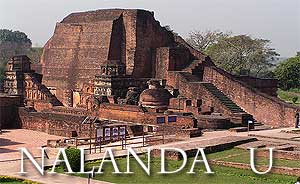
The historic Nalanda University was essentially a Mahayana Buddhist Center of learning and had as its Directors (or Rectors) some of the learned Buddhist Monks then existing.
One reputed writer Alexander Berzin (2002) says:
"In the Indian Mahayana Buddhist monasteries, such as Nalanda, monks studied four systems of Buddhist tenets. Two – Vaibhashika and Sautrantika – were subdivisions of the Sarvastivada school within Hinayana. The other two – Chittamatra and Madhyamaka – were subdivisions within Mahayana."
Wikipedia says:
"Nalanda was one of the world's first residential universities, i.e., it had dormitories for students. It is also one of the most famous universities. In its heyday, it accommodated over 10,000 students and 2,000 teachers. Chinese pilgrims estimated the students between 3,000 and 5,000.
The university was considered an architectural masterpiece, and was marked by a lofty wall and one gate. Nalanda had eight separate compounds and ten temples, along with many other meditation halls and classrooms. On the grounds were lakes and parks. The library was located in a nine storied building where meticulous copies of texts were produced. The subjects taught at Nalanda University covered every field of learning, and it attracted pupils and scholars from Korea, Japan, China, Tibet, Indonesia, Persia and Turkey. During the period of Harsha, the monastery is reported to have owned 200 villages given as grants."
https://en.wikipedia.org/wiki/Nalanda
Among some of its famous Abbots were: Shakyashribhadra.  The scholar Dharmakirti (ca. 7th century), one of the Buddhist founders of Indian philosophical logic, as well as and one of the primary theorists of Buddhist atomism, taught at Nalanda. Both Mahayana Buddhism and Nalanda University influenced each other.
The old Nalanda University was a not secular University by any means. It had a Buddhist Character for over 700 years right from its beginnings in the Fifth Century A.D ( reign of Sakraditya ) until its unfortunate end in 1193, when the Nalanda University was sacked by Bakhtiyar Khilji, a Turk. The Persian historian Minhaj-i-Siraj, in his chronicle the Tabaqat-I-Nasiri, has reported that thousands of monks were burned alive and thousands beheaded as Khilji tried his best to uproot Buddhism.
The burning of the library had continued for several months and "smoke from the burning manuscripts hung for days like a dark pall over the low hills."
The last throne-holder of Nalanda, Shakyashribhadra, fled to Tibet in 1204 at the invitation of the Tibetan translator Tropu Lotsawa (Khro-phu Lo-tsa-ba Byams-pa dpal). In Tibet, he started an ordination lineage of the Mulasarvastivadin lineage to complement the two existing ones.
New proposed Nalanda International University
Nalanda University (also known as University of Nalanda) is the name of a proposed university in Rajgir, near Nalanda, Bihar, India. The first academic session is set to start from 2014.The university is a plan for reviving and re-establishing Nalanda University.
The University of Nalanda is proposed to be established under the aegis of the East Asia Summit (EAS), as a regional initiative. The NMG also has representatives from Singapore, China, Japan and Thailand.
The Governing Board of Nalanda University consists of:
  • Amartya Sen - Professor at Harvard University.
  • Sugata Bose - Professor at Harvard University.
  • Wang Bangwei - Professor at Peking University.
  • Wang Gungwu - Professor at National University of Singapore.
  • Susumu Nakanishi - Professor at Kyoto City University of Arts.
  • Meghnad Desai - Emeritus Professor at London School of Economics.
  • Prapod Assavavirulhakarn - Professor at Chulalongkorn University.
  • George Yeo - Former Minister for Foreign Affairs of Singapore.
  • Tansen Sen - Associate Professor at Baruch College, CUNY.
  • Nand Kishore Singh - Member of Parliament - Rajya Sabha, India.
  • Chandan Hareram Kharwar - Pune university - India.
Comment
There is a huge difference in the scope and direction of the old and the proposed new Nalanda University.
Whereas eminent Buddhist scholar monks were the rectors of the famed old Nalanda University, in the proposed new set up there does not appear to be a single Buddhist monk on the Board of Governors. The overwhelming majority of the Governors have ' secular' credentials including the leader of the Project,  Amartya Sen - Professor at Harvard University. Lay Buddhists are very much in the minority on the Board of Governors. There is no Sri Lankan presence on the Board  despite this country's claim to have the oldest continuing Buddhist civilization in the world.
Most of Sen's public pronouncements on this subject lately have been on the wisdom and validity of ' Secularism' over and above the innate value and depth of the Indian spiritual Heritage which includes Buddhism. It shows that it pays to be a secularist even for an Indian in Western Professional and academic circles. But it is tantamount to blasphemy to downsize your own i.e. Indian wisdom and religious heritage, merely to display that one is on the right side of intellectual fashion in the West. Amartya Sen illustrates this proposition vividly.
It is unlikely that some one from the Middle East or Muslim country would try to create a secular place of learning on top of a destroyed site of a reputed Islamic Tertiary Institution.
That is unthinkable.
In Buddhist and Hindu societies 'secularists' have come to the fore and are now engaged in a state of play going virtually unchallenged downsizing the influence and scope of the traditional religions which built the unique civilizations that we find in India and Sri Lanka and still attract the attention and wonder of the world.
Related story: Nalanda Without Buddhist Participation?
sourse: Buddhist channel