
by Claude Arpi, Niti Central, March 23, 2015
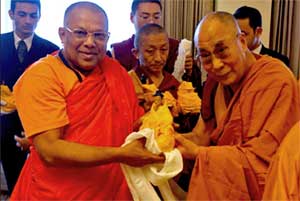 The Dalai Lama told his Sri Lankan colleagues:
“We are all followers of the same Buddha. At a time when scientific minded people are expressing some doubts about religion, many of them are expressing an interest in aspects of the Buddha’s teachings.”
The Tibetan leader added:
“To think of yourself as different from them, as someone special, is to create distance and a barrier between yourself and others, which can lead to isolation and loneliness.”
Unfortunately this is what has happened between the different Buddhist schools over the years (or perhaps centuries). The Sri Lankan monks who attended the meet, were the heads of the three principal traditions of Sri Lanka: the Ramanya, Shiyam and Amarapura Nikayas; the President of the Mahabodhi Society was also present. The spokesman of the Sri Lankans later explained their presence in Delhi:“We discussed the Vinaya all day. We compared the Theravada and Mulasarvastivada traditions, which are the Vinaya traditions of Sri Lanka and Tibet respectively, and found no significant differences between them.”
During their meeting with the Dalai Lama, the Theros expressed the unanimous wish to see him in Sri Lanka soon.
This religious happening has however some strong political connotation and it is a direct outcome of Prime Minister Narendra Modi’s recent visit to Sri Lanka.
In Colombo, Mr. Modi affirmed:
“Sri Lanka is where Buddhism has truly flourished.”
Later, he paid a visit to Sri Lanka’s ancient capital Anuradhapura and offered prayers at the sacred Mahabodhi tree. It was a strong gesture, especially as he was accompanied by the Sri Lankan President, Maithripala Sirisena. Both spent 30 minutes at the Mahabodhi tree temple and performed some special Buddhist rituals.
Already during his official visit to Japan, the Prime Minister had reminded his hosts:
“Buddhism from India has inspired Japan for over a millennium.”
This is important at a time when China tries hard to take the leadership of the Buddhism movement in Asia.
On October 27, 2014, The Buddhist Channel, a global news platform which provides news on Buddhism, reported ‘China lays claims to Leadership of the Buddhist World’.
Xinhua elaborated:
“Hundreds of the world’s Buddhists gathered at an ancient temple in northwest China’s Shaanxi Province to open the World Fellowship of Buddhists’ 27th general conference. Congregating around a relic said to contain one of the Buddha’s finger bones at the Famen Temple in Baoji City, more than 600 representatives from 30 nations and regions were in attendance.”
When it is convenient, Communist China believes in the Buddha (and in the reincarnation of Buddhist masters); already in 1957, on the occasion of the 2500th anniversary of Gautam Siddharth’s birth, Zhou Enlai, the Chinese Premier (and hardcore Communist), brought ‘back to India’ some relics of the Great Monk.
Dr Kalinga Seneviratne, who, in October, attended the WFB in Shaanxi on behalf of the German Dharmadutta Society delegation from Sri Lanka, praised China:
“Though not officially acknowledged, China is today home to between 200-300 million Buddhists thus making it the country with the world’s largest Buddhist population. The restored grand Buddhist temples in Baoji and in close by Xian, and the impressive Buddhist cultural display at the opening ceremony of the WFB meeting if is anything to go by, it indicates that Chinese Buddhism has undergone a remarkable revival.”
Beijing always finds sycophants to support its claims and eulogise China’s ‘correct’ attitude.
The highlight of the conference was the speech of the Chinese-selected Panchen Lama, Gyalsten Norbu who urged Buddhists worldwide to jointly strive for deepened exchange and cooperation and work together to boost environmental protection and safeguard world peace. Norbu told the international gathering:
“Buddhism has already integrated into the Chinese culture and it is recognised by the Chinese government. For over thousand years Tibetan Buddhism has become the precious gem of the Chinese nation.”
Of course, there is another side to the coin: while Buddhism is promoted for ‘political reasons’ outside China, it is banned for entire sections of the society inside the country.
One can understand: 200 or 300 million ‘official’ Buddhists could be very subversive for the regime. Today, the membership of the Communist party is a small percentage of these figures, how could Buddha be more popular than Karl Marx in the Middle Kingdom?
Till the recent meet between the Sri Lankan monks and the Dalai Lama, the Tibetan Buddhist tradition (known as the Nalanda tradition) has had very few contacts with the Theravada School or Hinayana, which is prevalent in Myanmar, Sri Lanka, Thailand or Laos. It is quite regrettable.
For political reasons (Beijing’s pressure), the Dalai Lama has never been able to visit Nepal, Bhutan, Sri Lanka, Myanmar or even Bangladesh where a tiny Buddhist minority lives.
Sri Lanka’s Modi initiative is most welcome; the time has indeed come for Dharamsala to create a South Asian Bureau for Buddhists Affairs to facilitate a Buddhist Union. A delegation of respected (Tibetan or Indian) Buddhist figures should at the earliest visit the South Asian capitals and start establishing contacts with local Buddhists.
With the strong support of the Modi Sarkar, it should not be impossible.
In this perspective, it was refreshing that New Delhi took the initiative to host a dialogue between Theravada Theros and Tibetan/Himalayan monks of Nalanda tradition on some aspects of the Vinaya. It was a first exchange since decades.
The Vinaya dialogue was organised by the International Buddhist Confederation (IBC). It was a long way since November 2011, when before the Global Buddhist Congregation (GBC), organised by the Ashoka Mission in New Delhi (with an attendance of some 900 monks and nuns from over 40 countries), Beijing objected to the presence of the Dalai Lama in one of the functions. After China threatened to call off the 15th round of the border talks between the Special Representatives, the then Indian government backed out: both the Prime Minister and President were suddenly too ‘busy’.
Interestingly, the Sri Lankan and ‘Nalanda’ delegations informally met over tea at the residence of Minister of State for Home Kiren Rijiju, a native of Arunachal Pradesh. The most respected Prof. Samdhong Rinpoche, a former prime minister of the Central Tibetan Organisation was present for the occasion.
This current dialogue should definitely be extended to other Buddhist countries of the region.
And there is no reason why a country which treats its religious minorities so badly, should take the leadership of the Buddhist movement in Asia. The problem is that Beijing has a lot of money to invest in ‘soft’ diplomacy and many are tempted.
Tail End: It is regrettable that Amartya Sen could not understand that it was one of roles of the Nalanda University to organise such fruitful dialogues.
SOURSE:BUDDHIST CHANNEL


 A
newly published paper reports this trade-off may not be universal. It
finds calling to mind concepts of one major world
religion—Buddhism—boosts both selfless behavior and tolerance of people
we perceive as unlike ourselves.
A
newly published paper reports this trade-off may not be universal. It
finds calling to mind concepts of one major world
religion—Buddhism—boosts both selfless behavior and tolerance of people
we perceive as unlike ourselves.
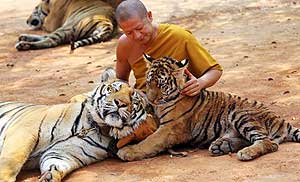 <<
A Thai Buddhist monk playing with tigers at the 'Tiger Temple' in
Saiyok district in Kanchanaburi province, west of Bangkok, on Feb 12,
2015. Wildlife protection officials say they found no mistreatment of
the more than 100 tigers at the temple, one of the country's most
popular destinations for foreign tourists. — AP pic
<<
A Thai Buddhist monk playing with tigers at the 'Tiger Temple' in
Saiyok district in Kanchanaburi province, west of Bangkok, on Feb 12,
2015. Wildlife protection officials say they found no mistreatment of
the more than 100 tigers at the temple, one of the country's most
popular destinations for foreign tourists. — AP pic To
the Buddhist, the potter is only a series of point instants. In one of
this instant, it is followed by the first moment of the series of point
instant called a pot. It is an impersonal process, they is no enduring
Ego’s working on the pot. The cause ceased to exist when the effect is
produced. To the Buddhist, simultaneous existence of cause and effect is
not possible. It is only possible when both are static and causation is
than an imagination.
To
the Buddhist, the potter is only a series of point instants. In one of
this instant, it is followed by the first moment of the series of point
instant called a pot. It is an impersonal process, they is no enduring
Ego’s working on the pot. The cause ceased to exist when the effect is
produced. To the Buddhist, simultaneous existence of cause and effect is
not possible. It is only possible when both are static and causation is
than an imagination. <<
In this Sunday, Jan. 18, 2015 photo, Afghan Archaeologist Jawid
Muhsenzada, speaks about the history of a Buddha statue inside a cave in
Mes Aynak valley, some 40 kilometers (25 miles) southwest of Kabul,
Afghanistan. The hills overlooking this ancient trade-route city, where
the buried treasures of Afghanistan’s Buddhist history hide beneath
sandy soil, are so rich in copper that they gleam green in the morning
sun. Photo: Rahmat Gul, AP
<<
In this Sunday, Jan. 18, 2015 photo, Afghan Archaeologist Jawid
Muhsenzada, speaks about the history of a Buddha statue inside a cave in
Mes Aynak valley, some 40 kilometers (25 miles) southwest of Kabul,
Afghanistan. The hills overlooking this ancient trade-route city, where
the buried treasures of Afghanistan’s Buddhist history hide beneath
sandy soil, are so rich in copper that they gleam green in the morning
sun. Photo: Rahmat Gul, AP 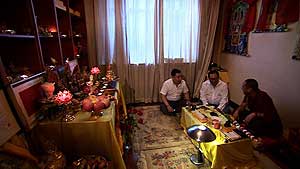 << Xiao Wunan, a former senior Communist Party official and Geshe Sonam next to Xiao's shrine in his apartment
 <<
The mummified remains, covered in cattle skin, were found on January 27
in the Songinokhairkhan province. Picture: Morning Newspaper
<<
The mummified remains, covered in cattle skin, were found on January 27
in the Songinokhairkhan province. Picture: Morning Newspaper 

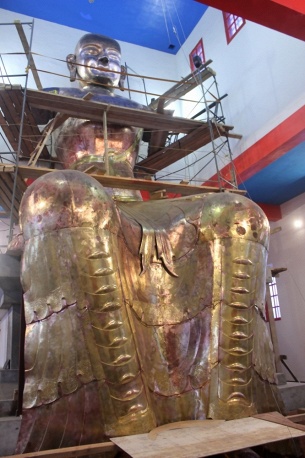 She
said the local authorities have allocated more than $1.1 million to
sponsor the restoration works. Aginsky Datsan monks will put together
all remaining fragments of the 16-meter statue originally made by
Chinese craftsmen and will make new elements to substitute for missing
fragments.
She
said the local authorities have allocated more than $1.1 million to
sponsor the restoration works. Aginsky Datsan monks will put together
all remaining fragments of the 16-meter statue originally made by
Chinese craftsmen and will make new elements to substitute for missing
fragments. Archaeological
digs have been taking place for over 70 years at the Phanigiri hillock
near Nalgonda, in India’s southern province of Telangana. The recent
discovery however, represents one of the most significant yet made at
the site.
Archaeological
digs have been taking place for over 70 years at the Phanigiri hillock
near Nalgonda, in India’s southern province of Telangana. The recent
discovery however, represents one of the most significant yet made at
the site.
 The
senseless Paris attacks and the ensuing "Je suis Charlie" phenomenon
have brought these questions to the fore. Many feel torn between modern
values that liberate their individual self and traditions that give them
a precious sense of identity and group belonging.
The
senseless Paris attacks and the ensuing "Je suis Charlie" phenomenon
have brought these questions to the fore. Many feel torn between modern
values that liberate their individual self and traditions that give them
a precious sense of identity and group belonging. As
a Buddhist, the undertaking of the precepts is the most basic practice
that cuts across all major Buddhist traditions. As a ritual, Buddhists
often recite the Five Precepts on a daily basis to remind themselves of
their duties to self and society.
As
a Buddhist, the undertaking of the precepts is the most basic practice
that cuts across all major Buddhist traditions. As a ritual, Buddhists
often recite the Five Precepts on a daily basis to remind themselves of
their duties to self and society. As
Rev W. Rahula points out, though the label ‘Buddhist’ is of little
significance from a Buddhist’s unique point of view, there is a long
established tradition in this regard in Buddhist countries, which is
that for a person to be considered a Buddhist they must ‘take refuge’ in
the Triple Gem (Buddha, Dhamma and Sangha) and undertake to observe the
Five Precepts (the Pancasila – the five minimum moral obligations of a
Buddhist: not to kill, steal, commit adultery, utter falsehoods, or take
intoxicating drinks).
As
Rev W. Rahula points out, though the label ‘Buddhist’ is of little
significance from a Buddhist’s unique point of view, there is a long
established tradition in this regard in Buddhist countries, which is
that for a person to be considered a Buddhist they must ‘take refuge’ in
the Triple Gem (Buddha, Dhamma and Sangha) and undertake to observe the
Five Precepts (the Pancasila – the five minimum moral obligations of a
Buddhist: not to kill, steal, commit adultery, utter falsehoods, or take
intoxicating drinks). 