
Bernama, Apr 16, 2015
Hanoi, Vietnam -- Buddhist bikku (monk) Thich The Tuong
has been working hard to turn his one hectare farm into a bamboo
conservatory on the Son Tra Mountain, which is the home for over 110
bamboo species including the four considered on the verge of extinction
in Viet Nam.
 <<
Buddhist bikku Thich The Tuong works at the bamboo conservation garden
on Son Tra Mountain. VNS Photos Cong Thanh HA NOI (VNS-BERNAMA)
<<
Buddhist bikku Thich The Tuong works at the bamboo conservation garden
on Son Tra Mountain. VNS Photos Cong Thanh HA NOI (VNS-BERNAMA)The garden, located on the Son Tra mountainside, eight kilometres from the city centre is open to all visitors, who wish to see bamboo conservation in a rural setting, along with a fishing pond and a stone installation.
"It has been a long and hard journey since I planted the first bamboo. I loved gardening since I left my native village of Vy Da to enter religious life at a small pagoda in Con Hen in Hue," said Tuong.
"I left the pagoda after my master died and found the Quan The Am Pagoda in Da Nang to continue my religious life."The garden was donated by a farmer in Son Tra after he became too tired to plant any trees. I worked the land and grew different bamboo species that I had collected from different provinces," he recalled.
"I have collected a third of the total 300 bamboo varieties in Viet Nam. Bamboo plantation has grown over the past decade, dotting the sloping hills of the Son Tra Mountain."
He said he had named the garden Son Tra Tinh Vien (Son Tra Tranquil garden).
A CONNECTION BETWEEN BAMBOO AND BUDDHISM
The 48-year-old monk said he had settled down in the area and started looking after thegarden as he wanted to continue with his religious work and preserve the bamboo gene at the same time. "I studied literature at HCM City's Social Sciences and Humanities College, so I found a connection among bamboo, literature and Buddhism," he explained.
"The Bamboo garden is my effort to preserve nature on the Son Tra Mountain, which has been recognised as a nature reserve. It would help protect the evergreen peninsula in the tourist city in the future," he said.
"Bamboo has inspired me to compose poems and literature, as well as lead a religious life. I have also created a tranquil corner in the garden for religious meditation," he said.
Four bamboo species feared on the verge of extinction are growing well in the garden.
THE MONK'S GARDEN A BAMBOO GENETIC POOL
Meanwhile, Le Thi Thoa, an ex-student of biology and environment at the Da Nang's Teachers' Training college, said the garden was literally a bamboo genetic pool.
"I spent two years working on a thesis on bamboo, and the garden was my approach for research. The monk assisted me considerably in my study of bamboo," Thoa said.
"It is a precious garden of bamboo genes in Viet Nam as bamboo forests on the upstream have been over-exploited or destroyed. Bamboo is rare in villages as the local people prefer to grow CASH crops or profitable plants," she said.
Thoa, who is a teacher at a junior secondary school in A Luoi District of Thua Thien-Hue, said she had proposed the idea of growing bamboo in environmentally polluted areas in Da Nang.
"I had read a document saying that bamboo reduces the content of dioxin in soil or air. Other plants cannot grow because of the chemical contaminating the air or land, but bamboo can develop well anywhere," she said.
The 25-year-old teacher said the development of more bamboo conservation centres would help protect valuable sources of flora and their genes in Viet Nam.
"Bamboo also plays a role in biodiversity, along with other plants. It is a source of food for animals in the forest. Bamboo can slow down heavy floods upstream and smooth downstream flows," said Nguyen Thi Tinh, a biologist from the Frankfurt Zoological Society of Germany.
"Land for bamboo in rural villages has been reserved for farming or urban development. So, the ever green plant has gradually disappeared," she said.
She said bamboo was also symbolic of the vitality and power of Vietnamese culture and its people.
BAMBOO IS VERSATILE
The monk said he had brought species from Japan, Thailand, India and Africa, whenever he visited these countries. "Bamboo can be grown as bonsai in a family garden or can be sold in the market. People just think bamboo is for construction of cottages, but it can be a source of craft in rural areas," he explained.
"Bamboo is also used as raw material for production of bamboo charcoal-based toothpaste or tooth brushes in China and Korea," he said.
The monk is worried that he will not be able to preserve the garden as the city plans to convert the farm into a tourist resort.
"I had proposed better alternatives for the bamboo conservatory, but the city's departments or agencies are yet to respond," he said.
"The directorate of the private Duy Tan University had asked me to move the garden to the university village as a field research project for students. However, I am still hesitant as I am waiting for a decision from the city authorities regarding the garden," he said.
"I will devote the garden to Da Nang as it could promote the city as a bamboo conservation centre in Viet Nam," he said.
The garden is a favourite photography spot for young people on the weekends, since it is still rare to find a precious bamboo genetic garden in the central region.


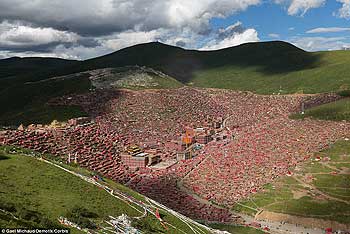 <<
Larung Gar Buddhist Academy is home to 40,000 monks and nuns, who
travel to the settlement of Sertar to study Tibetan Buddhism
<<
Larung Gar Buddhist Academy is home to 40,000 monks and nuns, who
travel to the settlement of Sertar to study Tibetan Buddhism
 Patience
is the main antidote to anger. As common wisdom says: just count to
100… During this time, any of the below methods can be effective. The
most effective method will depend on the actual situation. Especially in
our age of rush and intense change, patience may not be seen as a
positive quality, but take a minute to think about it – impatience can
easily give rise to a general feeling of anger.
Patience
is the main antidote to anger. As common wisdom says: just count to
100… During this time, any of the below methods can be effective. The
most effective method will depend on the actual situation. Especially in
our age of rush and intense change, patience may not be seen as a
positive quality, but take a minute to think about it – impatience can
easily give rise to a general feeling of anger. Nevertheless,
she’s teaching a sophomore seminar on the topic this semester — the
campus’s second such offering over the past year.
Nevertheless,
she’s teaching a sophomore seminar on the topic this semester — the
campus’s second such offering over the past year. I’ve
long since lost count of the number of Vipassana retreats that I’ve
offered, probably somewhere between 500 – 750 ranging from one month to
one day. However it is many years since I have described myself as a
Vipassana teacher, preferring the much broader term, Dharma teacher. The
word Vipassana has become too closely identified with certain methods
and techniques, and is thus far removed from its original meaning,
namely insight – bearing no connection whatsoever for the Buddha with a
meditation technique. That doesn’t disqualify Vipassana as a healthy and
challenging practice. There is no telling how many individuals have
entered a course or retreat, residential or non-residential, East or
West, but the number certainly runs at least into hundreds of thousands
or a million or two in the last three decades or so.
I’ve
long since lost count of the number of Vipassana retreats that I’ve
offered, probably somewhere between 500 – 750 ranging from one month to
one day. However it is many years since I have described myself as a
Vipassana teacher, preferring the much broader term, Dharma teacher. The
word Vipassana has become too closely identified with certain methods
and techniques, and is thus far removed from its original meaning,
namely insight – bearing no connection whatsoever for the Buddha with a
meditation technique. That doesn’t disqualify Vipassana as a healthy and
challenging practice. There is no telling how many individuals have
entered a course or retreat, residential or non-residential, East or
West, but the number certainly runs at least into hundreds of thousands
or a million or two in the last three decades or so.


 Breathe
in; breathe out. Yeah, I can do this. Feeling good; but I must remember
to weed the garden, and I definitely have to send an email to, woops,
back to breathing in, breathing out, breathing in, breathing - actually I
have to ring a friend, and what did she mean when she said….. What
rubbish is going on in my head? I thought meditation was supposed to
settle the mind, not make it an uncontrollable swirling mess.
Breathe
in; breathe out. Yeah, I can do this. Feeling good; but I must remember
to weed the garden, and I definitely have to send an email to, woops,
back to breathing in, breathing out, breathing in, breathing - actually I
have to ring a friend, and what did she mean when she said….. What
rubbish is going on in my head? I thought meditation was supposed to
settle the mind, not make it an uncontrollable swirling mess.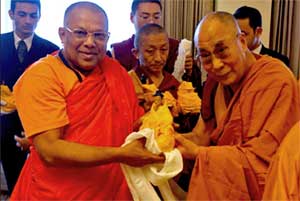 The Dalai Lama told his Sri Lankan colleagues:


 A
newly published paper reports this trade-off may not be universal. It
finds calling to mind concepts of one major world
religion—Buddhism—boosts both selfless behavior and tolerance of people
we perceive as unlike ourselves.
A
newly published paper reports this trade-off may not be universal. It
finds calling to mind concepts of one major world
religion—Buddhism—boosts both selfless behavior and tolerance of people
we perceive as unlike ourselves.
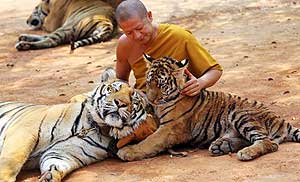 <<
A Thai Buddhist monk playing with tigers at the 'Tiger Temple' in
Saiyok district in Kanchanaburi province, west of Bangkok, on Feb 12,
2015. Wildlife protection officials say they found no mistreatment of
the more than 100 tigers at the temple, one of the country's most
popular destinations for foreign tourists. — AP pic
<<
A Thai Buddhist monk playing with tigers at the 'Tiger Temple' in
Saiyok district in Kanchanaburi province, west of Bangkok, on Feb 12,
2015. Wildlife protection officials say they found no mistreatment of
the more than 100 tigers at the temple, one of the country's most
popular destinations for foreign tourists. — AP pic To
the Buddhist, the potter is only a series of point instants. In one of
this instant, it is followed by the first moment of the series of point
instant called a pot. It is an impersonal process, they is no enduring
Ego’s working on the pot. The cause ceased to exist when the effect is
produced. To the Buddhist, simultaneous existence of cause and effect is
not possible. It is only possible when both are static and causation is
than an imagination.
To
the Buddhist, the potter is only a series of point instants. In one of
this instant, it is followed by the first moment of the series of point
instant called a pot. It is an impersonal process, they is no enduring
Ego’s working on the pot. The cause ceased to exist when the effect is
produced. To the Buddhist, simultaneous existence of cause and effect is
not possible. It is only possible when both are static and causation is
than an imagination. <<
In this Sunday, Jan. 18, 2015 photo, Afghan Archaeologist Jawid
Muhsenzada, speaks about the history of a Buddha statue inside a cave in
Mes Aynak valley, some 40 kilometers (25 miles) southwest of Kabul,
Afghanistan. The hills overlooking this ancient trade-route city, where
the buried treasures of Afghanistan’s Buddhist history hide beneath
sandy soil, are so rich in copper that they gleam green in the morning
sun. Photo: Rahmat Gul, AP
<<
In this Sunday, Jan. 18, 2015 photo, Afghan Archaeologist Jawid
Muhsenzada, speaks about the history of a Buddha statue inside a cave in
Mes Aynak valley, some 40 kilometers (25 miles) southwest of Kabul,
Afghanistan. The hills overlooking this ancient trade-route city, where
the buried treasures of Afghanistan’s Buddhist history hide beneath
sandy soil, are so rich in copper that they gleam green in the morning
sun. Photo: Rahmat Gul, AP 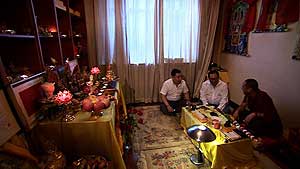 << Xiao Wunan, a former senior Communist Party official and Geshe Sonam next to Xiao's shrine in his apartment